Smart Contracts & Workflows
Updated 27 Nov 2026
Kambria DAOs run their votes, shared fund and money through the Kambria DAOs Framework (KDF): a set of smart contracts (small programs on a blockchain, here Polygon) and the KDF app. When a DAO earns revenue, the framework receives it, labels it, splits it by a rule the DAO set in advance, and pays out what is owed. Every step is recorded publicly, so nobody has to take anyone's word for the numbers.
This is KDF v2. In v2 the votes, the shared fund, GT and LP are part of the framework itself (the first version used XDAO), and members sign in with an email and a passkey instead of installing a wallet app.
Where it lives: the KDF app (kdf.kambria.io), together with the DAO Workbook (daowb.kambria.io) for plans, deliverables and the Cashbook.
How money moves
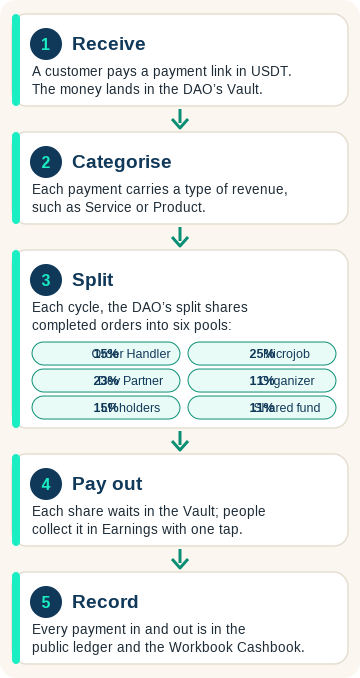
- Receive. A customer pays a payment request in USDT through its email link. The money lands in the DAO's Vault, tagged with that request.
- Categorise. Each payment carries a revenue category, such as Service or Product.
- Split. Each cycle (a week or a month), an Operator proposes the split: the DAO's split version divides each completed order into six pools.
- Pay out. Each person's share is set aside, and they collect it with one tap in Earnings (Kambria pays the network fee). Task payments run in their own Microjob cycles, approved by a second person. Spending from the shared fund needs a passed vote.
- Record. Every payment in and out shows in the DAO's public ledger and flows into the DAO Workbook's Cashbook.
Roles at a glance
Find your role
- Members & LP holdersJoin the DAO, vote, make proposals and collect earnings. LP holders have put money into the DAO and share in its revenue.8 pages
- Order HandlersAny approved member who sells for the DAO: create payment requests, add co-handlers and mark orders completed.4 pages
- OrganizersLook after the DAO's day-to-day settings: members, Operators, revenue categories, the split, task rates and the IP record.7 pages
- OperatorsRun the money rounds: propose revenue-sharing cycles and send Microjob task lists.2 pages
- Task approversCheck and approve each Microjob task list before anyone is paid. Never the Operator who sent it.1 page
- GuardiansCan pause payouts for up to 14 days in an emergency and cancel a passed proposal before it runs. They cannot move money.3 pages
- Customers & the publicPay a DAO, read its public ledger and check its IP record. No account needed.3 pages
- Kambria OpsCreate DAOs with the framework and look after the shared settings.2 pages
- HelpThis part of the guide is for everyone who uses the Kambria DAOs Framework: members, LP holders, Order Handlers, Organizers, Operators, task approvers, Guardians and Kambria Ops.2 pages
How the roles work together
- Kambria Ops creates the DAO. One step sets up its GT, LP, voting, shared fund, Vault, split, Microjob and IP record.
- The Organizer approves members, gives the Operator and Task approver roles, and sets the categories, the split and task rates.
- An Order Handler creates a payment request. The customer pays through the link, and the order is marked completed once delivered. After a set number of days (7 by default), anyone approved in the DAO can mark it delivered.
- At the end of each cycle, an Operator proposes the revenue-sharing cycle. Anyone can recheck it during a check period, then each share waits in the Vault.
- For task payments, an Operator sends a Microjob task list, a Task approver approves it, and the amounts are set aside from the task budget.
- Members collect what they are owed in Earnings, or the DAO switches on automatic payouts. Anyone can check every step in the public ledger.
Votes and the shared fund
- GT gives voting rights: 1 GT = 1 vote. GT cannot be sold or transferred; only a DAO vote gives or takes it.
- A proposal passes when Agree votes reach the quorum (34% of all GT by default) and Agree beats Disagree. Voting lasts 3 days by default.
- A passed proposal waits 2 days before it can run, so a Guardian can cancel it if something is wrong.
- The shared fund only pays out through a passed proposal. Each DAO sets its own quorum and times, and changes them by vote.
- Control moves to the DAO step by step. At first Kambria holds the Organizer role and changes settings by a set process; when the DAO is ready, it votes to hand the role to its shared fund, and from then on every change needs a vote.
The contracts behind it
- Factory: creates the full set for a new DAO in one step and registers it.
- GT, Governor and Treasury: voting rights, proposals and votes, and the shared fund that only a passed vote can spend.
- LP: records money put into the DAO (about 1 USDT ≈ 1 LP) and remembers balances over time, so each cycle uses the balance on its closing date.
- Payment Desk: payment requests and orders, each paid once through its own link.
- Vault: receives payments, keeps the split versions and holds each person's share until they collect it.
- Microjob: task rates, the task budget and approved task lists.
- IP Registry: each DAO's IP record, held in the DAO's shared fund.
What each DAO decides
- Which pools it uses and the share of each, in its master plan.
- Its revenue categories, task rates and how many days until anyone in the DAO can mark an order delivered.
- Its quorum, voting time and waiting time.
- Who its Organizer, Operators, Task approvers, Guardian and members are.
Example: DEP 3. The Circles DAO runs on Polygon with USDT and starts from the standard six-pool split: Order Handler 15%, Microjob 25%, Dev Partner 23%, Organizer 11%, LP Holders 15%, Treasury 11%. Kambria holds the Organizer and Guardian roles at first and checks payouts by hand while the framework earns trust. See the Circles DAO page under Model DAOs and DEP 3 Docs.
The first version
KDF v1 used XDAO for votes and the shared fund, with separate Revenue Splitter, Payout Executor, Vault and Microjob Payment contracts. KDF v2 replaces it; the Circles DAO starts directly on v2.
How it works
- How task payments workKambria DAOs pay members per task: for finished work that passes review, not for time.
- How the Workbook and the Framework work togetherThe DAO Workbook holds a DAO's plan and work: the Roster, deliverables, the Cashbook and the record of votes.
- KDF TermsThe words you will meet in this guide and in the app, explained simply, from A to Z.
- How the IP declaration hash is madeThis page is the public rule for the check code (hash) of a DAO's IP declaration.