Kambria DAOs Documentation
Kambria DAOs provide a structured framework for communities, partners, and organizations to co-own, govern, and scale innovations through decentralized collaboration.
This documentation serves as a comprehensive reference for understanding how Kambria DAOs work in practice - from conceptual models and governance principles to smart contracts, workflows, and real-world execution.
Kambria DAOs are designed to support a wide range of innovations, including:
- Technology solutions
- Service and social impact initiatives
- Capacity and knowledge exchange models
- Educational, organizational, and coordination frameworks
Rather than focusing only on governance mechanics, the Kambria DAOs Framework defines an end-to-end execution model that aligns ownership, participation, accountability, and value sharing across the full lifecycle of an innovation.
What This Documentation Covers
This site documents the reference framework that underpins all Kambria DAOs. It explains:
- How innovations are proposed, developed, and co-owned
- How governance is structured and implemented
- How contributors, partners, and communities participate
- How value and responsibility are allocated transparently
- How smart contracts support execution and accountability
- How DAOs evolve from experimentation to mature operations
The documentation is structured into the following main sections:
Overview of Kambria DAOs
Introduces the core concepts, principles, and lifecycle of Kambria DAOs as a mechanism for co-owning innovation.
Model
Describes the Kambria DAOs Model - a reference architecture for decentralized innovation - including governance structures, partnership-based execution, value frameworks, and IP co-ownership.
This section explains:
- What a mature Kambria DAO looks like
- How ownership, governance, and execution remain aligned at scale
- How the framework applies beyond technology to broader forms of innovation
Governance
Explains how Kambria DAOs govern themselves with the Kambria DAOs Framework, including:
- Governance Tokens (GT)
- Proposal types and voting processes
- Quorum rules and decision execution
- The role of the DAO Council and contributors
- How governance evolves over time
Smart Contracts & Workflows
Documents how Kambria DAOs are executed in practice, including:
- DAO creation: GT, LP, voting and the shared fund in one step
- LP and how money put into a DAO is recorded
- Payment requests, revenue sharing and task payments (Microjob)
- IP records and the public ledger
- How the framework works with the DAO Workbook
This section focuses on how things work, rather than why they exist.
DAO Workbook
Documents where a DAO plans and records its work: the Roster, lanes and Key Results, the Workplan, deliverables and their three-step review, the Cashbook, votes and KAT. The DAO Workbook is part of the Kambria DAOs Framework and has a step-by-step guide for every role.
Model DAOs
Introduces real DAOs that serve as reference implementations of the framework, including:
- Circles DAO, the DAO of DEP 3
- Tech-powered Elderly Care DAO (TECD)
- Capacity Exchange DAO (CED), paused in DEP 3
These Model DAOs demonstrate how the framework is applied across different innovation domains.
How to Navigate the Kambria DAOs Framework
The Kambria DAOs Framework is intentionally comprehensive, but it is not designed to be adopted all at once.
Instead, the ecosystem follows a progressive learning and adoption path:
Bottom-Up: DAO Experimentation Program (DEP)
DEP is the primary entry point for contributors and builders.
It starts with:
- Small, time-bound DAOs
- Simple scopes and limited risk
- Lightweight governance
- Clear execution goals
DEP enables learning through hands-on participation before scaling complexity.
Middle Layer: Model DAOs
Model DAOs bridge experimentation and the full framework.
They demonstrate selected parts of the model in real contexts, making abstract concepts concrete and learnable.
Top-Down: Full Kambria DAOs Framework
The full framework describes:
- Mature governance structures
- Partnership-based execution
- Financial and value-sharing logic
- Smart contract orchestration
- IP and asset co-ownership mechanisms
This level is most relevant for long-term DAO organizers, partners, and ecosystem designers.
Conceptual progression:
DEP Cohorts → Model DAOs → Full Kambria DAOs Framework
This progression allows:
- Learning before scaling
- Execution before abstraction
- Participation before authority
Core Principles
Across all sections, the Kambria DAOs Framework is guided by three foundational principles:
- Good governance
Transparent decision-making, accountability, and adaptability. - Social responsibility
Alignment with real-world impact, ethical execution, and sustainability. - Equitable value sharing
Distribution based on contribution, responsibility, and participation.
These principles are embedded directly into DAO structures, workflows, and smart contract logic.
Who This Documentation Is For
This documentation is intended for:
- DAO organizers and architects
- Contributors and DAO members
- Partners and service providers
- Builders integrating smart contracts and workflows
- Communities exploring decentralized co-ownership models
Readers can engage with this documentation at different levels, depending on their role and interest — from conceptual understanding to operational execution.
Purpose of This Documentation
The purpose of this site is to provide:
- A clear reference model for Kambria DAOs
- Shared language and structure for governance and execution
- Transparency into how DAOs operate in practice
- Learning resources for evolving decentralized innovation models
Together, the pages that follow form a practical, extensible framework for co-owning and scaling innovation through Kambria DAOs
Kambria DAOs model
The Kambria DAOs Model describes how innovations—across technology, services, and social impact—are proposed, developed, co-owned, and scaled through decentralized collaboration on Kambria.
Pages in this part
- Kambria DAOs – A Way to Co-own InnovationKambria DAOs are designed to enable communities, partners, and organizations to co-own the development and commercialization of innovations through a decentralized and collaborative model.
- Kambria DAOs Governance ModelKambria DAOs govern themselves with the DAO core of the Kambria DAOs Framework (KDF v2): governance tokens, proposals and votes, and a shared fund that only a passed vote can spend.
- How to become a DAO Council memberThis page explains how contributors can become DAO Council members through active participation in DAO businesses, rather than through token holding alone.
- NFT IPs of Technology Solutions in Kambria DAOsThis page explains how NFTs are used to represent intellectual property (IP) of innovation solutions within Kambria DAOs.
- Kambria Codebase – From KDNA to NFT ApproachThis page explains the evolution of how intellectual assets and codebases are represented, governed, and shared in the Kambria ecosystem — from the early KDNA (Kambria DNA) concept to the current…
- DAO Product & Service Sales Revenue SharingThis page explains how revenue generated from DAO products and services is shared among stakeholders in Kambria DAOs using smart contract–based mechanisms.
- Introducing Model DAOsKambria introduces Model DAOs as reference implementations of the Kambria DAOs Framework.
Smart Contracts & Workflows
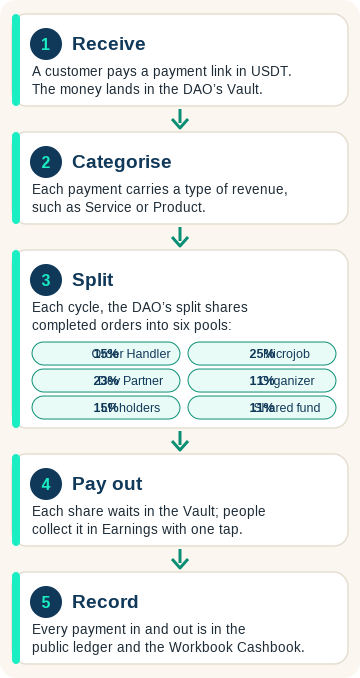
Kambria DAOs run their votes, shared fund and money through the Kambria DAOs Framework (KDF): a set of smart contracts (small programs on a blockchain, here Polygon) and the KDF app. When a DAO earns revenue, the framework receives it, labels it, splits it by a rule the DAO set in advance, and pays out what is owed. Every step is recorded publicly, so nobody has to take anyone's word for the numbers.
Find your role
- Members & LP holdersJoin the DAO, vote, make proposals and collect earnings. LP holders have put money into the DAO and share in its revenue.8 pages
- Order HandlersAny approved member who sells for the DAO: create payment requests, add co-handlers and mark orders completed.4 pages
- OrganizersLook after the DAO's day-to-day settings: members, Operators, revenue categories, the split, task rates and the IP record.7 pages
- OperatorsRun the money rounds: propose revenue-sharing cycles and send Microjob task lists.2 pages
- Task approversCheck and approve each Microjob task list before anyone is paid. Never the Operator who sent it.1 page
- GuardiansCan pause payouts for up to 14 days in an emergency and cancel a passed proposal before it runs. They cannot move money.3 pages
- Customers & the publicPay a DAO, read its public ledger and check its IP record. No account needed.3 pages
- Kambria OpsCreate DAOs with the framework and look after the shared settings.2 pages
- HelpThis part of the guide is for everyone who uses the Kambria DAOs Framework: members, LP holders, Order Handlers, Organizers, Operators, task approvers, Guardians and Kambria Ops.2 pages
How it works
- How task payments workKambria DAOs pay members per task: for finished work that passes review, not for time.
- How the Workbook and the Framework work togetherThe DAO Workbook holds a DAO's plan and work: the Roster, deliverables, the Cashbook and the record of votes.
- KDF TermsThe words you will meet in this guide and in the app, explained simply, from A to Z.
- How the IP declaration hash is madeThis page is the public rule for the check code (hash) of a DAO's IP declaration.
DAO Workbook
The DAO Workbook is where a Kambria DAO plans and records its work: the Roster, lanes and Key Results, the Workplan, deliverables and their three-step review, attendance, the Cashbook, votes and KAT recognition. It replaces the DEP 3 Workbook spreadsheet and is part of the Kambria DAOs Framework: plans and work live in the Workbook, while votes, payments, revenue sharing and IP records live in the KDF app.
Where it lives: daowb.kambria.io. Members sign in with the same email as in the KDF app (kdf.kambria.io).
How it works with the framework
- One person, one account: the same person ID in both apps, and the DAO's members in the framework come from the Workbook's Roster.
- Paid tasks: task types and rates come from the Workbook's Pay-Per-Task Scheme, and deliverables verified in the Workbook become the framework's task lists (Microjob).
- Money: the Cashbook mirrors what the framework records on-chain (payments in, revenue shared, payouts) instead of recording it twice.
- Votes: votes held in the KDF app are copied into the Workbook's Votes page.
These connections are being built in stages; until each one is ready, the Workbook page says what to record by hand.
Roles in the Workbook
Find your role
- MembersSign in, read the Roster, follow the Workplan, submit deliverables, see attendance, Credits, Karma and KAT.12 pages
- Lane ownersSet their lane's boundary and Key Results, plan its tasks, review deliverables (step 1) and write the lane weekly report.6 pages
- DAO LeadKeeps the DAO settings, Roster, lanes and roles, the Pay-Per-Task Scheme and the Budget Plan; reviews deliverables (step 2) and records votes.9 pages
- BookkeeperSets up the holders, records money movements and checks actual balances at month-end.4 pages
- OrganizerSets the KAT Config, logs and verifies Credits, sets Karma and settles KAT each month.4 pages
- FacilitatorMarks attendance, reviews deliverables (step 3), audits the Cashbook and KAT, closes the month and scores the proposal report.9 pages
- Kambria OpsAdds people and DAOs, gives the DAO Lead and Facilitator roles, keeps the shared catalogs and imports Workbook spreadsheets.8 pages
- HelpThis part of the guide helps everyone who uses the DAO Workbook, whatever their role.4 pages
Model DAOs
Model DAOs are real-world implementations of the Kambria DAOs Framework, created to demonstrate how the framework operates in practice across different types of innovation.
Pages in this part
- Circles DAOThe Circles DAO is the one DAO of the DAO Experimentation Program, Cohort 3 (DEP 3).
- Tech-powered Elderly Care DAO (TECD - Model DAO)At TECD (Tech-powered Elderly Care DAO), we believe that meaningful elderly care is built through collaboration.
- Capacity Exchange DAO (CED - Model DAO)Paused in DEP 3 (Cohort 3): Kambria is focusing on Kambria Circles, and CED partners are invited to join Kambria Circles.